loading
Welcome to Gulf Global Commerce (GGC), your trusted partner in international trade, connecting the Middle East with the world. At GGC, we specialize in the efficient and reliable import and export of essential raw materials, serving diverse industries across the globe.

Contact Info

Social Links

Benzene

Gulf Global Commerce (GGC)

Benzene: A Vital Aromatic Hydrocarbon for Global Industries

Welcome to Gulf Global Commerce's dedicated page for Benzene, a critical chemical compound in various industries worldwide. As a leading import/export platform, GGC ensures reliable sourcing and delivery of high-quality benzene to destinations across the Middle East and globally, adhering to all international safety and regulatory standards.
What is Benzene?

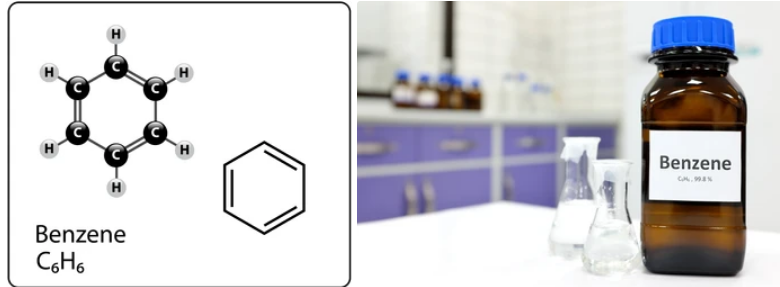
Benzene (C 6 ​ H 6 ​ ) is a flammable, colorless liquid with a sweet, aromatic odor. It's the simplest aromatic hydrocarbon, characterized by its unique cyclic structure of six carbon atoms bonded in a ring, each connected to one hydrogen atom.Benzene is a natural component of crude oil and is also formed in various industrial processes.

Key Properties and Characteristics

Understanding benzene's properties is crucial for safe handling, storage, and transportation.
Molecular Formula: C6H6 ​
Molar Mass: 78.11 g/mol
Appearance: Colorless liquid
Odor: Sweet, aromatic, gasoline-like
Boiling Point: 80.1 °C (176.2 °F)
Melting Point: 5.5 °C (41.9 °F)
Density: 0.876 g/cm³ (lighter than water)
Solubility: Slightly soluble in water; highly soluble in organic solvents like acetone, ethanol, and ether.
Flammability: Highly flammable liquid and vapor.
Toxicity: Highly toxic and carcinogenic, known to cause various health issues, including blood disorders and leukemia, with prolonged exposure.
Gulf Global Commerce (GGC)

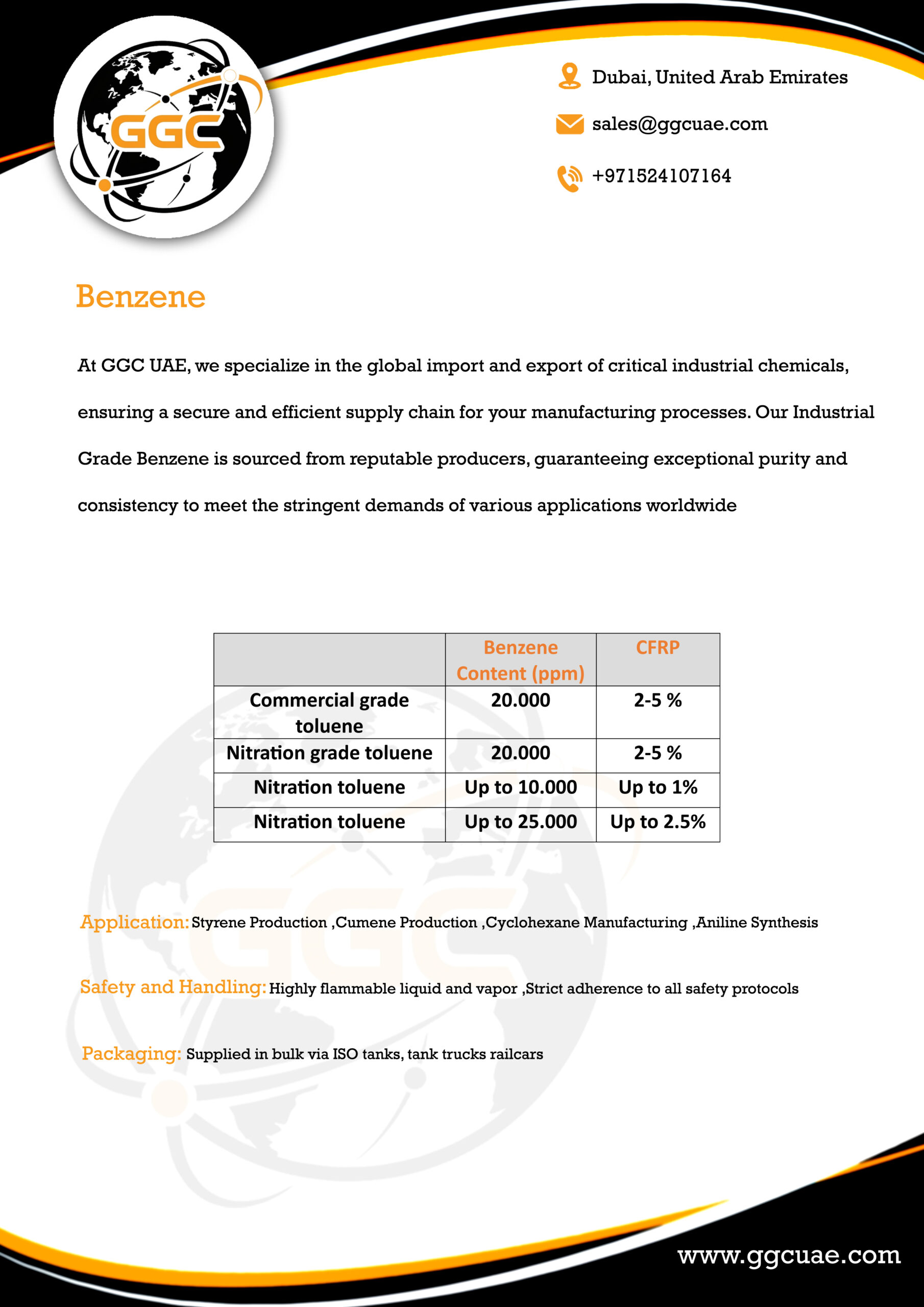
Gulf Global Commerce Benzene Data Sheet

Gulf Global Commerce (GGC)

Industrial Applications of Benzene

Benzene is a fundamental building block in the petrochemical industry, serving as a precursor for a vast array of downstream products. Its primary applications include:
  • Styrene Production
    Over 50% of global benzene production goes into manufacturing ethylbenzene, which is then used to produce styrene. Styrene is a monomer essential for making polystyrene plastics, synthetic rubbers, and resins.
  • Phenol and Acetone Production
    Benzene is a key ingredient in the cumene process, yielding phenol and acetone. Phenol is used in resins, plastics, and pharmaceuticals, while acetone is a common solvent.
  • Cyclohexane Production
    Cyclohexane, derived from benzene, is crucial for producing nylon precursors like adipic acid and caprolactam, widely used in textiles and engineering plastics.
  • Aniline Production
    Benzene is converted to nitrobenzene, which is then reduced to aniline, a vital intermediate for dyes, rubber chemicals, and polyurethanes.
  • Detergents
    Alkylbenzenes, produced from benzene, are key components in the manufacture of various detergents.
  • Other Uses
    Benzene is also used in the production of synthetic fibers, lubricants, pesticides, and certain dyes. Historically, it was used as a solvent and an additive to gasoline, though these uses have been significantly restricted due to its toxicity.
Export and Import Regulations:

Hazardous Materials Transportation: Benzene shipments must comply with international codes for dangerous goods transportation (e.g., IMDG Code for sea, ICAO/IATA DGR for air, ADR for road, RID for rail).

Prior Informed Consent (PIC) Regulation: In regions like the EU, benzene is subject to PIC regulations (aligned with the Rotterdam Convention), ensuring that importing countries receive prior notification and consent to manage the risks associated with the substance. This is particularly relevant for exports to and from countries with strong chemical safety frameworks.

Country-Specific Regulations: Each destination country, including those in the Middle East, will have its own import requirements, licensing procedures, and safety standards for hazardous chemicals. Gulf Global Commerce is committed to navigating these complex regulations to ensure compliant and smooth transactions. For instance, Middle Eastern countries often have specific regulations for chemical imports, including requirements from authorities like FANR (Federal Authority for Nuclear Regulation) in the UAE, which governs commodities subject to non-proliferation. Saudi Arabia also has regulations for chemical imports via Cabinet Decision No. 143/1427.

Documentation: Comprehensive documentation, including Material Safety Data Sheets (MSDS/SDS), certificates of analysis, origin certificates, and export/import licenses, is mandatory for all benzene shipments.